Moby – "future quiet" Album Release
A Refuge in Fourteen Chapters

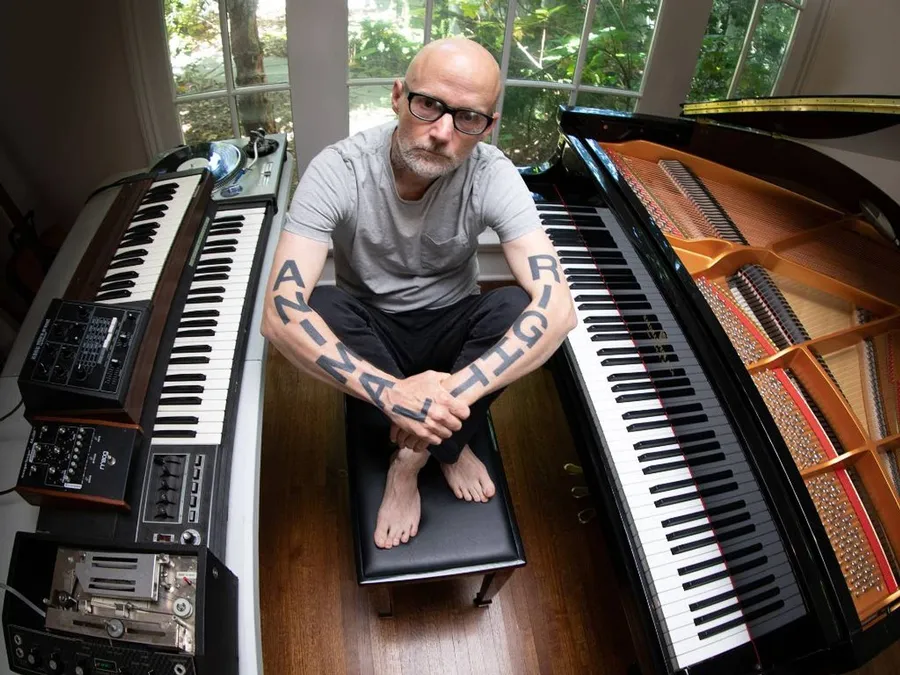
"future quiet" by Moby is finished, and the release of this fantastic new album is just around the corner. It will be available from February 20th. I'll admit it: when I got the message I'd get to listen to "future quiet" in advance, I had to pause for just a moment. It really moved me, and I still feel honoured in moments like this. Today, I'd like to share my impressions with you.
Moby is no neutral figure for me. If you've read my interview with him from the summer of 2024, you already know that. He is one of those artists who make me think. As someone who sees music as an essential part of life, as a human being, and as a vegan. For me, his work is always a call to keep going. Even when the world is screaming a little louder than yesterday. Or especially then. And that is exactly what this record is about.
"future quiet" is Moby's 23rd studio album. It will be released on February 20th via BMG. This is not a record you'll simply put on in the background. And it's not an album you need to analyse to understand. It's an album you feel. Or rather: as you listen, you'll notice how these 14 songs slowly and steadily press your shoulders down, until you realise just how tense you've been all along.
Silence as a Stance

Moby described it best himself, as he so often does—precise, honest, without any detours:
"The world screams at us, our screens scream at us, other people scream at us, and to retreat from the screaming, we need safety and refuge. That, for me, is the goal of Future Quiet. Writing and recording it was a refuge for me, and I hope that listening to it is a refuge for you."
That sounds like the very same Moby who told me in our interview how he thinks about activism in the long term. Not as a fire you ignite and let burn out, but as something you nurture. Every single day. With yoga in the garden, with vegan pizza, with music that leaves room to breathe. "future quiet" is the musical counterpart to that philosophy.
Fourteen tracks. Restrained piano, expansive ambient soundscapes, carefully chosen vocal features. Not a single unnecessary note. No bombast inflating itself to impress. Instead, depth that only reveals itself once you've stopped actively listening and simply allowed yourself to be present.
The Opening: A Deepening
Those who read my album announcement already know: "future quiet" opens with an orchestral version of "When It's Cold I'd Like To Die", the song that first appeared on "Everything Is Wrong" in 1995 and reached an entirely new generation through its emotional use in the Netflix series "Stranger Things". It has since become Moby's most-streamed track. A song without drums or bass, never officially released as a single. That says everything, doesn't it?
The new version with Jacob Lusk is not a reinvention. It is a deepening. Jacob, best known for his work with the acclaimed Gabriels, brings his unforgettable voice to the song. Moby himself describes his voice as "transcendent", and I honestly can't think of a better word. Strings, silence, that voice. It's an opening that makes one thing immediately clear: this is no ordinary record.
Fourteen Chapters, One Language

Then comes "This Was Never Meant For Us". The track begins floating and pensive. The piano carries Moby's vocals, which speak of pain and hope, of saying goodbye to times gone by. "All the years left us broken"—that one line says more than entire albums by some artists. If that sounds like the song only offers one perspective, it doesn't. "This Was Never Meant For Us" evolves. It gains breadth. And at some point, it simply lets the worries drift away.
"Retreat" is playful and thrives on its contrasts. The piano enchants and carries you forward; echoes of earlier pieces surface in the background, carried into our present by the gentle hiss of tape. Then the violin enters, revealing the beauty of our world. So unaffected, so direct, that it aches. Listening, I find myself thinking: we should meet this world with so much more love. Not only can it heal, but it can live freely without fear. But so that we ourselves can recover and come to know what peace actually feels like.
"Estrella Del Mar", featuring Elise Serenelle, is as delicate, serene, and radiant as a glowing star above a brilliantly blue sea. Elise Serenelle's classical vocals are heartbreaking; the interplay with the woodwinds in the background is simply perfect. The foundation, as so often on this album, is Moby's piano.
Then: "Ruhe". The German word for "quiet" carries not only peace within it, but also thoughtful uncertainty—the feeling of not knowing what waits on the next page. Moby continues to spin this story, his piano accompanying him along the way. Light filters through faintly at first, then grows stronger, until it finally blazes up and sweeps away all doubt. A piece that sounds exactly the way it is named, and still so much more.
"Mott St 1992" hits me in a deeply personal way. Mott Street runs through Little Italy and Chinatown in Manhattan—right in the heart of the New York that shaped Moby so profoundly in the early nineties. 1992 was the very time when he was rooted as a young musician in the underground scene of that city. Clubs, raves, that eclectic energy we also talked about in our interview. The title feels so strongly like his personal look back. The feelings from that unimaginable time rise up again. The memory wraps around everything, and while listening, it carries me to places of my own past. Oh, that organ. It's pure magic. Suddenly, I'm surrounded again by people I once danced with all night, cheering on DJs, watching the sunrise from the top of a rusty scaffold. In the early morning hours, loud birdsong would greet us as we stepped out of a steaming club. With shoes danced to pieces and wild, dishevelled hair. One place, one year, one memory. Nostalgia, but not tinged with sadness—more like a quiet thank-you to a time that shaped Moby and his art. That shaped all of us.
"Precious Mind" follows seamlessly. Gentle brushes stroke the drums, the piano works its magic, and India Carney's voice fills the room. You might know her from The Voice US (Season 8, 2015). Her timbre, her feeling, her emotion give you goosebumps. The violin accompanies her, and the two become one. I want more of this. I want so much more of this.
Tallinn, the capital of Estonia, is considered one of the best-preserved medieval old towns in Europe. It is calm and pulsating, melancholically beautiful and forward-looking all at once. Moby has a deep connection to Europe, to that particular kind of quiet, historical weight that you feel in Nordic and Baltic cities—and all of it fits perfectly into the world of "future quiet". The city of Tallinn and the country of Estonia must have left a lasting impression on Moby. Not only because he will be performing again in the Estonian city of Tartu in August, and played at the Õllesummer Festival in Tallinn back in 2009, but also because his music reflects everything that makes this city what it is. Its vastness, the warmth of its summers, the cold of its winters, its winding lanes, the kindness and hospitality of its people. Listening, you sink in and find yourself wishing you could just be there—for a moment, a week, a year. A homage to a city, and perhaps also a gentle question: why aren't more cities like Tallinn? Innovation meets cosiness and warmth, and lovingly preserved traditions meet a genuine joy in new ideas.
"On Air". The broadcast is live. The curtain lifts. The tension rises. A sonata. "Tears in your eyes, but the love isn't there". serpentwithfeet's vocals bring yet another wave of goosebumps. Hollywood dreams, tender playfulness. This song wants to be heard in grand concert halls. Particularly beautiful are the small details: the delicate percussion, like spring blossoms pushing their gentle heads through the heavy velvet of these layered compositions. You may already know the track from the previous album, "Always Centered At Night". On "future quiet", Moby gives it a new context, and within it, the song unfolds even deeper than before.
"Selene" is a beautiful piece of chamber music. The piano keys are palpable and audible, creating a sense of closeness and familiarity.
"Le Vide" fits perfectly into the world of "future quiet". Even though it deals with emptiness, I wouldn't see that emptiness here in its conventional sense. It feels more like meditative, monastic, withdrawn stillness—the quiet and the inward gaze, the allowing of thoughts to drift before something creative can emerge. Particularly striking, once again: the strings.
"Great Absence" carries something I find difficult to put into words. Many see "future quiet" as the direct successor to Moby's minimalist album "Ambient 23" from 2023—and in this track, that connection is especially palpable. Moby's dreamy, playful piano forms the foundation here, too. The song evokes grief that slowly dissolves into silence. It never fully disappears—it's always present, only changing its form, wearing a different dress over time. You're gone. But are you really gone?
"Mono No Aware" takes its title from the beautiful Japanese aesthetic concept 物の哀れ, which can be roughly translated as "the transience of things"—though that doesn't quite capture it. It describes that tender, bittersweet feeling that arises when you recognise that everything is impermanent. Not grief in the heavy sense, but rather a quiet sense of being moved by the beauty of the fleeting. In Japan, it is often connected to the sight of falling cherry blossoms—so beautiful precisely because they don't last. And that is exactly how this song sounds. Like cherry blossoms barely touching the ground before they dissolve, like snowflakes. The green grass receives them, becomes greener still through them, and the cycle of nature begins anew. For me, this is one of the absolute highlights of "future quiet". It expresses the very heart of what this album means to me. That ability to feel the beauty of the impermanent within the silence, without fighting it. It is also a deeply honest Moby title—one that reflects everything Moby is as an artist, as an animal rights activist, as a person who has lived vegan for 35 years. All the doubts and the constant wish to keep going. Not to give up. To see activism as a long-distance run, and to celebrate every small step forward.
"The Opposite Of Fear"—what could the opposite of fear be? Courage and fearlessness, boldness, but also trust, compassion, and empathy. This piece carries all of that within it, and in doing so forms the perfect conclusion to "future quiet". It sounds futuristic, optimistic, and full of hope. It brings warmth and joy for what is yet to come.
Roots and the Present

What moves me so much about "future quiet" is the way Moby carries his history and keeps on telling it. Without ever looking back with sadness. It always moves forward. He played in hardcore punk bands. He DJed in clubs where volume was a language in itself. And yet he says:
"At the same time, I needed the refuge of quiet records like This Mortal Coil, The Cocteau Twins, Eno & Bowie's ambient works, Górecki, Arvo Pärt and others. 'future quiet' is definitely the product of all these influences—I can't count the number of times I've listened to ‘Song to the Siren' or Joy Division's 'Atmosphere'."
You can hear it. Not as a quote or a homage, but as lived DNA. This record sounds like a person who has listened to an enormous amount of music—and at some point began keeping only what truly remains.
More Than Music
Moby wouldn't be Moby if "future quiet" were a purely sonic project. It is also a stance. Those who know him—his animal rights activism, his consistent donation of tour proceeds, his film "Punk Rock Vegan Movie", his production company Little Walnut, his podcast "Moby Pod"—know this: with this artist, work and values are inseparable. This record carries the same integrity.
And perhaps that is what moves me most of all. In a time when loudness is mistaken for meaning, Moby amplifies the quiet and stands up for the gentle sounds. He proves that stillness is not surrender. It is quite the opposite. It is a powerful form of resistance.
Why You Should Listen to "future quiet"
Are you asking a little too much of yourself right now? Do you sometimes lie awake at night, not knowing what to do with all those thoughts? Do you love silence but still occasionally miss the clubs? Do you love ambient, piano, punk, techno, and everything that makes life worth living? Do you believe that veganism and music are inseparably connected? Does all of this apply to you? Or even just one of these things? Then you absolutely must listen to "future quiet".
"future quiet" is released on February 20th, 2026, via BMG.
If you'd like to see Moby live: this summer he'll also be performing in Germany (among other countries)—on August 11th at the Open-Air at Filmnächte am Elbufer in Dresden, and on August 18th at the KUNST!RASEN Festival in Bonn-Gronau.
Moby Live
11.08.26 – Dresden / Open-Air at Filmnächte am Elbufer
18.08.26 – Bonn / KUNST!RASEN Festival in Bonn-Gronau
Reading tip: My exclusive interview with Moby from the summer of 2024 about his animal rights activism and his deep relationship with music.
Meet me on the socials: Check out my new Mastodon account @soundsvegan@mastodon.social and don't miss any updates!
You can also find me on Bluesky.


