Lynette from Bestial Mouths on "Dead Lines", veganism and empathy
"Empathy has to mean something when it becomes inconvenient"

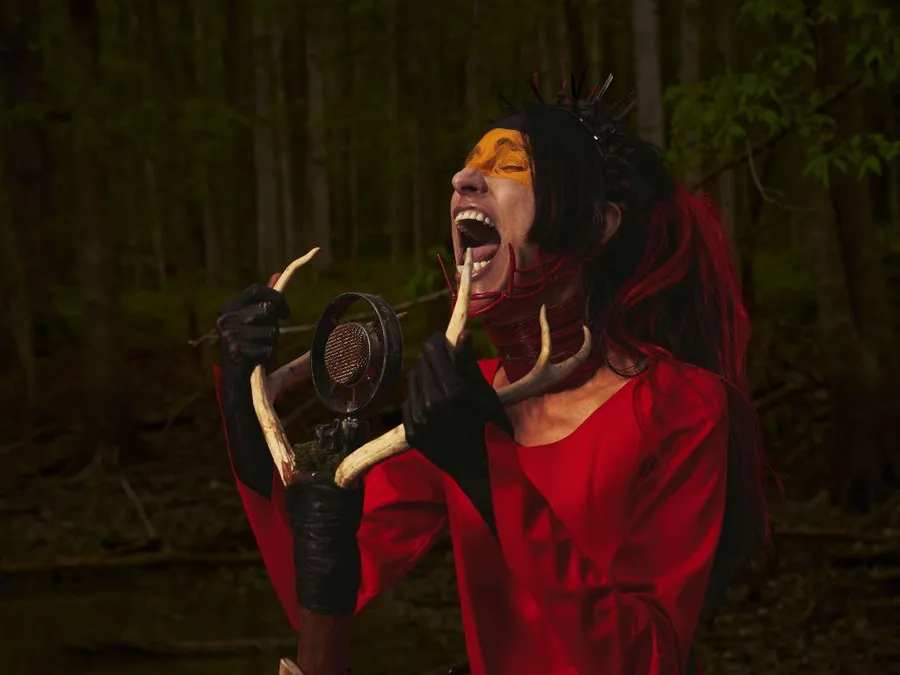
Last week I made the mistake of playing "Dead Lines in the background while I was doing my invoices. I’ll be honest: I didn't get many invoices done. Bestial Mouths have a beautiful way of pulling me out of whatever numb routine I'm stuck in, and on this record Lynette aims that pull straight at the systems that make us feel powerless. The songs deal with bodies other people want to control, with grief and with the quiet urge to disappear, and still the album keeps insisting that we don't have to live like this.
Musically, "Dead Lines" is the most direct record Lynette has made with Bestial Mouths since 2009. Her voice moves between ritual chant and raw scream, carried by dark, pulsing electronics that pull you straight onto the dance floor. In one song she demands her claws back in Spanish, and in another she lets Alexandria Ocasio-Cortez speak in the middle of a goth track, which I honestly did not see coming. Since this is Sounds Vegan, and you know what this magazine is all about, I was especially curious whether Lynette's idea of exploitation stops at the human species. Her answer is one of the clearest I have ever read from a musician. I had the chance to ask some questions. Please enjoy my interview!
Anne: Congrats on your new album, "Dead Lines". It turned out very well! You open the record with an incantation instead of a slogan. In "Chord" you sing:
"I am the weaver / Weaving the Thread of life / A tapestry of doom",
and then
"You have no right / We have no rights ... Cut the cord."
So you start with myth and ritual, not with anything openly political. Why open such a direct album that way? And why let the voice that weaves life also be the one that says "we have no rights"?
"Before something becomes political it's gotta become human"

Lynette: Bestial Mouths has always been about ritual for me, and before something becomes political it's gotta become human: fear, desire, survival, grief, anger, the messy things we carry in our bodies. I wanted to open the record by putting the listener into that space first, like an invocation. The weaver is about creation, but creation might not be beautiful. You can weave something that becomes a trap. That's where the contradiction in "I am the weaver" and "we have no rights" comes from. This feeling that we're constantly told we have agency, that we're responsible for our own lives, while at the same time so much of the world is constructed to take that agency away from us. And "you have no right / we have no rights" shifts that perspective. It's the realisation that the systems we're living inside can make everybody feel dispossessed. Who gets to decide what we're allowed to have, who we're allowed to be, whose body belongs to whom, whose voice matters?
Those questions are political, but they're also ancient. Thus the language becomes mythological: "Cut the cord", recognise the thing that's binding you and try to sever it, recognise that you don't have to keep participating in the same cycle. We don't have to live like that.
Anne: Bestial Mouths has existed since 2009, and you have watched the dark-electronic scene move through wave after wave of trends without ever chasing them. The press around "Dead Lines" calls it your most "polished and accessible" record, and it is also your most openly political. 17 years in, does making the most direct, most reachable Bestial Mouths album feel like a culmination or like a break with what the project has been? And who are you hoping finds this record who might have missed the earlier ones?
"The point is connection"
Lynette: Bestial has always been about growth and movement, and about creating what's in our souls rather than following whatever's happening around us. I've never wanted to make the same record twice, but I also don't want to abandon what makes Bestial so Bestial. I did want the emotion and the words to come through more directly. I've talked before about wanting people to be able to hear the journey in the vocals and connect with the story through their own experiences, and that's still very much a part of what I'm doing. The production is more polished but not softened. There's still a lot of anger, tension, vulnerability and ugliness in there. It's just being communicated in a way that hopefully reaches further.
The political side doesn't feel separate from the personal side to me. I've always written from lived experience, pain and trauma. At this point, it's impossible for me to separate those experiences from the larger systems and conditions that create them. "Dead Lines" became more communal in that sense. It's that feeling of being trapped under things that seem much bigger than you, but also about refusing to accept that as the only possible ending.
As for who I hope finds it, honestly, anyone who needs it! Folks who have never heard Bestial Mouths before, folks who hear themselves somewhere in these songs. The point is connection.
Anne: "HISS" plays like the information age rotting in real time:
"Subsets of actors / In this post-reality",
"Progress is fragile / As seeds become venom",
"Emblem of cult."
How do you write a protest song when the shared reality a protest usually appeals to has itself splintered into separate ones? And when you land on "emblem of cult", who, or what, did you have in mind?
"Progress isn't automatically good just because we call it progress"
Lynette: "HISS" is about what happens when the conditions for collective reality break down, when hatred gets dispersed through a culture, and it becomes hard to tell where personal anguish ends, and the machinery producing it begins. Everybody gets divided into subsets and factions; identity becomes performative; that's what I mean by "post-reality". Everybody is living inside a different version of the same turmoil, and you can't even appeal to a shared set of facts anymore because everything gets filtered through whatever someone has already attached themselves to. So the song is looking at the sickness underneath that fragmentation.
"Progress is fragile" is important because progress isn't automatically good just because we call it progress; it can still produce another generation of toxicity. That's the cyclical part of the song: the poison gets inherited. "Emblem of cult" wasn't written as a secret name for one particular person; I was thinking more broadly about the way people and ideas can become symbols for collective hatred or belonging. A cult can be political, religious or whatever; the point is the mechanism of devotion and division, when the emblem or symbol becomes more important than the human beings underneath it. "HISS" tries to sit inside that contradiction and make it impossible to ignore.
Anne: "Garras" is the fiercest moment on the album. In Spanish you demand:
"Dame mis garras / Devuélveme mis garras" ("give me my claws, give them back"),
and you sing
"We are all immigrants / On these stolen lands ... We are all damned."
Who are you demanding your claws back from? Why did you choose Spanish for this one?
"It's always been bigger than one person"

Lynette: The claws are really about instinctive self-defence and agency; they're something you're born with before life tries to declaw you, a symbol for what people lose in order to survive inside those systems. So, when I say, "Give me my claws back", it's a demand to recover something taken or suppressed. It's broader than one specific person or institution; it can be directed toward anything that teaches people to distrust their own power or separate them from their instincts. And the line "We are all immigrants / On these stolen lands" comes from thinking about history on a larger scale: displacement and borders are intrinsically part of our species' history, and I wanted to acknowledge that complexity. "We are all damned" is about recognising that we all inherit the consequences of the worlds built before us.
Spanish felt right because the song needed a different emotional register. Different languages carry different textures and histories inside them, and there was something about saying "Dame mis garras" that felt more physical. It just slaps harder.
Anne: Since 2018, Bestial Mouths has been your "sole project", built around your voice alone. In contrast, you described "Dead Lines" as "written together", and Brant speaks of "all of us in Bestial Mouths" being active in protests and advocacy. To make a record about communal solidarity, did you feel you had to turn Bestial Mouths back into an actual community, a band, rather than a vehicle for one person? What did you gain, and what did you have to give up as its sole author?
Lynette: I never stopped seeing Bestial as something larger than just myself. Even when it was technically my sole project, there were always collaborators, producers, musicians, other artists and people around me who helped shape it. It's always been bigger than one person in that sense. Brant is just amazing as a person and as a musician, and him producing gave the songs another body to move through, which was important for this particular record because the subject matter became much more collective: solidarity, resistance, exploitation, fear, the ways people become divided, the possibility of refusing those conditions together. It would have been strange to make a record about collective action while every creative decision came from me. So it's personal in a different direction.
Anne: The piece "Choke" is unmistakably about power over the body:
"Here / I was born a she / Punished for the air I breathe",
and the refrain
"You hold no real throne / Why do you dominate me."
If I'm correctly informed, fashion and activism for gender equality brought you to music. Sung in 2026, against rollbacks of reproductive and trans rights, "punished for the air I breathe" reads painfully literal. How much of "Choke" is autobiography, and what does denying an oppressor "any real throne" achieve that simply raging at him would not?
"Refuse the premise altogether"
Lynette: There's definitely autobiography, but not in the sense that every line describes a specific event or person. I've spent my life being aware of what it means to move through the world in a body that other people feel entitled to control or shame. That's something I've been addressing through my art for a long time. "Here I was born a she / Here punished for the air I breathe" is intentionally very direct. There are things you can experience so early and so repeatedly that they become part of your identity, that simply existing in your body can be a provocation. That's where the choking comes from. It's having your existence constantly constrained. Domination requires accepting the authority of the person dominating you. So when I say, "You hold no real throne", I'm taking that authority away, saying that you may have convinced yourself that you have some right to define or control me, but that's false. Refuse the premise altogether.
That's important to me because I wanted "Choke" to contain the moment where that relationship starts to break. "Why do you dominate me" puts the burden back where it belongs. And yeah, the political reality around women's bodies makes those words feel painfully current. I've been involved with reproductive-rights activism and watched how easily rights that people fought brutally hard to establish get treated as negotiable. That's part of why I don't see the personal and political as separate things; our bodies are political as long as other people and institutions keep trying to make decisions about them.
Anne: Most of "Dead Lines" is made for sweaty, packed venues, but "SILLK" slows right down to 90 bpm and turns inward:
"How I wish to wash away / How I wish to waste away"
"Bird who has no song"
"My rapture is imminent / My rupture is imminent"
On an album about refusing to be erased, this piece sounds like the private urge to disappear. Why did that moment of surrender belong on this record, and how do you keep a song about wanting to waste away from working against the album's insistence that "we don't have to live like this"?
"Sometimes you don't have a battle scream. Sometimes you barely have a voice"
Lynette: Resistance isn't a constant state. When you're exhausted, when you want to disappear and don't have the energy to fight it, that's valid too; those feelings are part of the same reality. This is the voice that wants relief from being overwhelmed, to not have to always be struggling. That's also why the imagery becomes so fragile: the bird without a song, unravelling strings, the rupture and rapture. Sometimes you don't have a battle scream. Sometimes you barely have a voice.
Anne: A question close to the readers of Sounds Vegan. Your visual world is central to Bestial Mouths, and you have credited "vegan leather accessories" in your wardrobe before, on "Resurrectedinblack". "Dead Lines" makes empathy political and targets systems of exploitation and extraction. Does that ethic reach the non-human, the animals caught in the same machinery of exploitation, and does it shape what you will and won't wear or eat? Or is that a line you would rather leave open for listeners to draw themselves?
"They're part of the same machinery of exploitation"
Lynette: For me, those things have never been separate. You can't talk about exploitation and extraction and then decide that animals exist outside of that conversation. They're part of the same machinery of exploitation. I've been vegan for a long time, and I don't think of it as just a dietary choice. That's actually something I've become more frustrated with over the years. Food is one part of it, but animals are also used for clothing, entertainment, research, cosmetics, all kinds of terrible things. The bigger question for me is:
Why do we accept the idea that another living being is a resource that exists for us to use?
That definitely affects what I wear and what I buy. The visual world of Bestial is important, but I don't want that aesthetic to depend on an animal having been killed for it. That's why you'll see vegan materials and accessories in the visual language. You can still have the darkness, the armour, the transformation and all that without needing somebody else's body to make it possible. It affects what I eat too, obviously, but I think focusing only on food can make the conversation smaller than it needs to be. The ethical question is much bigger than what's on your plate. It's about the relationship we have with other animals and whether we're willing to stop treating them as exploitable resources. That connects very directly to "Dead Lines". If I'm singing about systems that turn human beings into commodities or about extraction and domination, I can't pretend those ideas stop at the human species. Empathy has to mean something when it becomes inconvenient, otherwise it's just a word we put on a record.
I don't expect everyone listening to Bestial Mouths to arrive at the same place I have, but I do hope the record makes people question some of the structures they've been taught to consider normal, and that includes the way we relate to animals. It's all part of the same conversation.
Anne: "Deadening" turns its title into an order,
"Stop this deadening / We don't have to live like this",
and it samples Alexandria Ocasio-Cortez. Bestial Mouths has always worked with abstraction and voidic imagery, so putting a real, living, polarising US politician into a goth song is a big step. What made AOC the right voice for this? And do you worry about tying music meant to feel timeless to one specific political moment that could later date or sour?
There are things happening in the real world that don't need a metaphor"
Lynette: I used her voice because, at a certain point, I didn't want to hide behind abstraction anymore. Bestial has always had very symbolic language, and I love that world, but "Dead Lines" was written from a much more immediate place. There are things happening in the real world that don't need a metaphor put between them and the listener. That particular speech, the idea behind "we don't have to live like this", became kind of the spine of this song, recognising the deadening effect of all these systems that convince us that the conditions we're living under are inevitable. I wanted an actual human voice to interrupt and say, no, this isn't inevitable.
I didn't want the sample to turn the song into an endorsement of one politician or to make Bestial into a political campaign. AOC is a recognisable contemporary political voice, and that recognition is part of why the sample has weight. It puts a timestamp on the song: this is happening now to actual people. We're not speaking about some imaginary dystopia. I'm okay with the record being dated by its moment. Some of the most powerful political music is deeply rooted in the circumstances that produced it, and the emotion survives because the circumstances change shape rather than disappear.
Anne: The whole album keeps coming back to the fear of being erased, and "Shuttered" sounds like the grief hiding under that fear:
"I lost hold / In this maze",
"I wear you in the dust / on the language of",
"the scent of eternity ... well of souls."
It plays almost like carrying the dead with you. On a record aimed at systems "designed to erase us", is remembrance, refusing to let people be forgotten, its own form of resistance? Who are you carrying in "Shuttered"?
"Remembrance is totally a form of resistance"
Lynette: Remembrance is totally a form of resistance, especially when so much of the framework surrounding us is designed to make people disappear into noise and history. Remembering someone means refusing to let their existence be reduced to whatever happened to them. "Shuttered" is very personal in that way. "I wear you in the dust" is really about that residue of a person that stays with you, even when you can't reach them anymore. I don't want to name a single person and tell the listener who they're supposed to see there. Some of the people I'm carrying are mine, and some belong to a larger collective experience of loss. That ambiguity matters to me. You keep saying the names even if you only do it inside yourself. Death isn't something that's beautiful or romantic. When we carry someone forward, we're carrying their life, which becomes its own kind of survival for you both.
Anne: You have called "Dead Lines" a communal march and a rejection of nihilism, an album made for packed rooms and shared release. But a big cathartic show can also just let off steam. People scream, feel better for a night, go home, and nothing really changes. So when the song ends and the room empties, what do you hope people take with them? What do you want all that shared anger to turn into?
"You don't have to become numb in order to survive"
Lynette: It's more about breaking that feeling of isolation and remembering that what you're experiencing isn't only happening inside of you. A lot of what I'm writing about is that cycle where personal anguish gets separated from the systems and cultures producing it, and then we're encouraged to turn that anger against ourselves or against each other. I want the show to interrupt that for a moment, when you come into a room carrying all this frustration and realise there are other people carrying it too. What I hope people take home is that recognition, a little more clarity about what you're angry about and where that anger can go. Maybe it means refusing something you've been told you have to accept, or having somebody else's back, or maybe it's just remembering that you don't have to become numb in order to survive. The anger matters, but the destination is towards agency and connection.
Anne: If there were one thing in the world you could change, what would you choose and why?
Lynette: The way we treat each other, properly breaking the cycle where fear and hatred get passed down. I'd want people to be able to recognise each other instead of immediately looking for an enemy. If you could change that, a lot of other things would have the possibility to change with it.
Anne: What's up next for you?
Lynette: Currently I'm working on new music videos and our remix album for "Dead Lines", prepping for tour, making more of my upcycled jewellery Ruin To Rune1, spending time with my dogs, and maybe, someday, getting some proper rest.
Thank you for asking such thoughtful questions!
Bestial Mouths – "Dead Lines"
Fußnote
- 1.