CORDURA: 25 Years, 7 Albums and Eternal Night
Interview About Veganism and Making Music in Bilbao
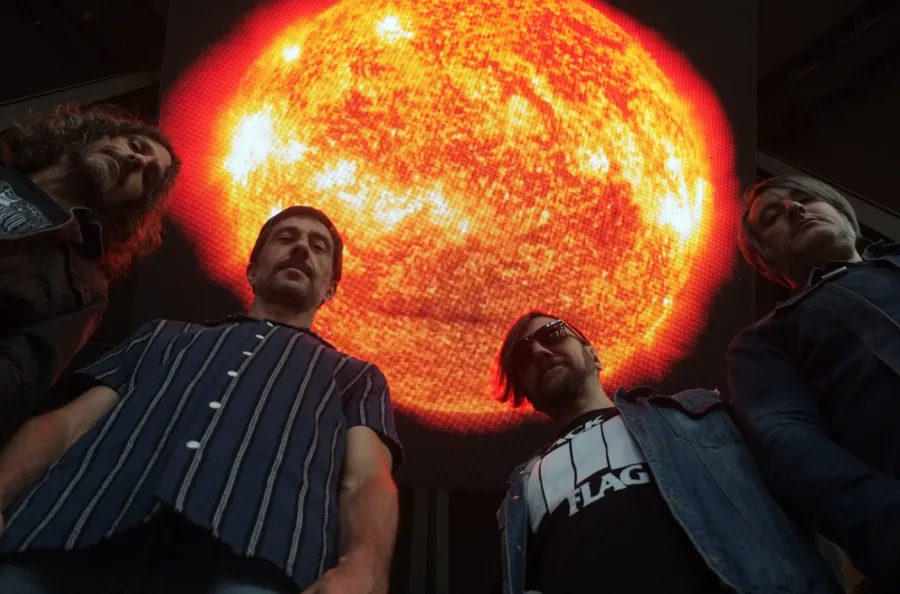
CORDURA vocalist and synthesiser player Anero reached out to me because he knew I care about music made by people who take their values seriously, and I built Sounds Vegan around topics such as animal rights and our environment. He has been vegan since 2000, Michi is vegetarian, and the band has played for animal rights initiatives and animal sanctuaries over the years without ever using that as a marketing angle. I'll be honest: that was the moment I finally started digging deeper into CORDURA's world. I think, that was far too late, and I knew immediately: I needed to find out everything. When I asked Michi what he would change about the world, I got one of the most direct, uncompromising answers I've heard from a musician on this so far. Please enjoy my interview with the basque space rock quartet!
The last time a William Blake quote refused to leave me alone was sometime in school. Then Anero got in touch, and suddenly it was back:
"Some are born to sweet delight, some are born to endless night."
The four musicians from Bilbao made that verse the centrepiece of their seventh album "Noche Eterna". Eternal night—not as a threat, but as a way of being. CORDURA have been together for 25 years, released seven albums since their 2003 debut, and sounds a little different on each one than they did on the previous. Their sound moves between psychedelia, garage rock, proto-metal and dark folk, recorded at Silver Recordings Studios in Bilbao with producer Martín Guevara (also the driving force behind Bilbao band Cápsula), released simultaneously on nine independent labels. Right after came the band's first ever 7" vinyl: "Ultravioleta", two new songs for their anniversary, this time with artwork delegated to Branca Studio from Barcelona. The well-known studio has worked with bands like Converge, Foo Fighters, and Queens of the Stone Age. The lineup: vocalist and synthesiser player Sergio Anero, guitarist Michi, bassist Beko, and drummer Unai.
Anne: CORDURA has been together for roughly 25 years now, with the four of you, Anero, Michi, Beko and Unai, having shared that journey for most of it. What does it actually feel like, on a day-to-day level, to still be making music together after a quarter century? Is it more like a band, or more like your chosen family at this point?
Anero: Absolutely, this is a chosen family. Over these 25 years, we've gone through extreme life moments together, from the happiest to the hardest… and here we still are. Closer than ever.
Michi: Exactly. Without a solid personal relationship based on friendship, the band probably wouldn't still be alive today. But we also shouldn't forget the purely musical satisfaction the band gives us: the different evolutions, experiments, and the joy of composing (even if that phase can be painful). I think the key to the band's longevity is the combination of both things.
Anne: Your seventh album, "Noche Eterna", came out in January 2025. It feels noticeably rawer and more psychedelic than anything you'd done before. You've mentioned wanting it to be more visceral and garage-like, less perfectionist. Was that a conscious decision you made going into the recording, or did it emerge naturally once you started working at Silver Recordings with Martín Guevara?
"Maybe we leaned too far into the rawness"

Anero: I think it was 50/50. We've known Martín for many years and knew he would understand us immediately. Maybe we leaned too far into the rawness, but it was what we felt like doing at that moment.
Michi: Today, I see songs that benefited greatly from that approach and others that maybe didn't, because the album contains different tensions: some songs needed more rawness, while others required something broader, more atmospheric and polished. We did both as well as we could, considering the time limitations. In short, the urgent, rough songs came out stronger, while the more exploratory and experimental pieces may not have been fully developed as they could have been. Time was decisive there. Still, we're very happy with the album, although personally, I haven't listened to it since it came out, which always happens to me. Maybe I can answer better in a couple of years (laughs).
Anne: Nine tracks, nine labels co-releasing the record, that parallel feels almost too neat to be "accidental". Has working within a genuinely DIY network of small labels changed the way you approach making and releasing music? What does that philosophy mean to you practically in 2025?
Anero: Hahaha, I hadn't noticed that detail, good point. We've always been part of the underground DIY scene. For us, it's the natural way of doing things—also the one that requires the most effort—but usually the things that cost you the most are the most rewarding. We're very grateful to the labels supporting us and helping us continue releasing music, touring, and meeting wonderful people. That's the best part of this world.
Michi: I think it's the most genuine way to do things, at least for a band of our level and ambitions: collaboration or direct self-production. But self-producing is extremely expensive, both economically and logistically. We actually prefer collaborating because labels take care of your material, promote it, and distribute it… and we simply don't have the time to do everything ourselves. Co-releasing also involves mutual support, trust, and friendship, which we value deeply.
Anne: On "Noche Eterna", you use more synthesisers than ever before, and the vocals are often treated as texture rather than as a conventional lead element. Anero, as the voice and synth player in the band: How did you approach that shift, and were there moments where it felt risky to step away from the more expected role of a front person?
Anero: When I started using synthesisers, the idea was just to add occasional arrangements, almost anecdotal touches. Over the years, you gain knowledge and confidence—buying good gear also helps—and I felt it was finally time to fully explore the possibilities of keyboards. I even composed a song entirely based on synthesisers, "Carpe Omnia", although in the end, we added drums, bass, and guitar to make it more organic and less cold. As for the vocals, they had always been very upfront and melodic, but we wanted to twist that a bit, embrace psychedelia, and cover them in reverbs, distortions, and effects so the rest of the instruments could take more prominence.
Michi: The keyboards mainly came from the band's musical evolution and Anero's personal evolution with equipment and skills—one thing feeds the other. For me, it opened many possibilities because, as the only guitarist, I gained sound layers that allow me to play differently. I'm a huge fan of bands with keyboards. They add incredible colour, although they're not always necessary. That's the beauty of having a singer/keyboard player: the keyboards don't always need to be there, only when we want them.
Anne: Michi's guitar work is a real anchor across the album. "Escupir al Cielo" has one of those riffs that just locks in immediately. How does the songwriting process typically work between the four of you? Do songs start as guitar ideas, or is it more chaotic than that?
"He curses my ancestors"

Michi: I compose from the guitar, or first in my head and then on guitar, and I bring ideas to the rehearsal space. Sometimes they're primitive sketches to jam around, while other times the songs are provisionally complete because I already feel there's something solid there. The reason the guitars sound the way they do—and I humbly think they're expressive—is because I compose so the songs work instrumentally even without vocals. The vocals should improve, modify, or transform them, but the songs should already function on their own.
If I were a singer, maybe I'd compose guitar and vocals together, but I never do. I throw the difficult part onto Anero—he curses my ancestors—but eventually he comes back with something surprising. Other times, because he doesn't always understand what I mean, we work through the vocal ideas together and suffer together until we find the right approach. The final result always improves on what we imagined. With drums, I suggest cadences and changes to Unai, but patterns, fills, and embellishments are his territory. With Beko, sometimes I give him basic bass lines, but the final harmonies and arrangements are his. He's also very good at editing songs: changing the order of sections, removing unnecessary parts, or suggesting when something is missing. The four of us make a great creative team.
Anne: The title "Noche Eterna" (which means "eternal night") sits over an album that spans stoner, dark folk, proto-metal and psychedelia. Is the night a metaphor for something specific here, or more of an atmosphere, a mood you were chasing across all nine songs?
Anero: We always look for album titles with strength and evocative power. At first, we considered calling it "Carpe Omnia", but it felt too pretentious. We also have a song called "Carpe Noctem", and while thinking about the idea of night, we came across a poem by William Blake that says: "Some are born to sweet delight, some are born to endless night." We became fascinated by it as both a concept and a way of life (laughs).
Anne: You've just recorded a 7" called "Ultravioleta" to mark the 25th anniversary, two brand new tracks that apparently push things even further into progressive, ambient and krautrock territory. That sounds like a significant step beyond even "Noche Eterna." What was the starting point for those two songs?
Michi: Regarding "Ultravioleta", there was an album by Holy Wave called Adult Fear that I didn't understand at first, but one day it suddenly clicked for me. I started experimenting with exaggerated delays and reverbs in rehearsal until something emerged that I recorded on my phone. Later, a song by Goat captivated me because of its groove, and I directly composed with that drum feel in mind. Then this huge riff appeared for an epic fade-out ending, and I thought, "That's it." But Beko completely rearranged the structure and wanted the riff to become central to the song. The vocals later pushed it toward a more garage-oriented vibe in the spirit of Monster Magnet. Sonically, it turned out incredible.
"Camino a la Perdición" came from my fascination with the krautrock feel of the two songs on Laminated Denim by King Gizzard & the Lizard Wizard. That same influence is also all over the 2025 self-titled album by Motorpsycho, whom I saw live in Bilbao last September. During that concert, I decided I wanted to write something in that style, combining two huge influences from recent years.
Anne: Anero, you've been vegan since 2000, and Michi has been vegetarian for a long time, too. Over the years, CORDURA has supported animal sanctuaries, vegan events, and other initiatives aligned with those values. How central has that ethics been to who the band is? Is it something that consciously shapes what you do, or does it exist more quietly in the background?
"Just because it's unusual doesn't mean anything"

Anero: As part of the band's identity, probably not that much. We've never presented ourselves as flag-bearers of animal liberation or anything like that. For me, it's a personal way of life. It would feel fake to portray ourselves otherwise, especially since not all members are vegan or vegetarian. Still, it has influenced certain aspects of the band, like choosing ethically certified merchandise free from animal exploitation, even if it costs more. Whenever possible, we've participated in benefit shows and activities supporting those values, and we're happy to continue doing so.
Michi: Nothing much to add—I completely agree.
Anne: Playing for animal sanctuaries and vegan-focused events is not the most obvious move for a space rock and stoner band. Have those shows felt different to regular gigs? Do the audiences at those events respond to your music in a particular way?
Anero: I'd like to think people appreciate that you're there supporting the cause, regardless of the style you play, although surely some people get bored (laughs).
Michi: Just because it's unusual doesn't mean anything. Or maybe it says a lot about the absurd limits we impose on ourselves. A DIY band can absolutely play progressive rock or jazz, and a militant vegan band could even play Italian power metal or AOR—why not? I don't think musical taste or aesthetics should determine ethical or political convictions. But the truth is they often do, and that creates limiting stereotypes.
Anne: The Basque Country has an incredibly strong underground rock culture—self-managed venues like Kafe Antzokia, bands like Cápsula or Lisabö operating within the same DIY circuit, a real sense of mutual support that you don't find everywhere. How much does being from Bizkaia shape CORDURA's identity, and what does that network actually mean to you in practice?
"It's a life-changing experience"
Anero: We've been very lucky to be part of that support network and self-managed scene. It absolutely helped us grow as a band, playing in many autonomous venues and squats, and experiencing concerts and activities that wouldn't happen elsewhere. Discovering that as a teenager changes your mindset completely. You realise things can be done differently, outside established structures. It's a life-changing experience.
Michi: Without those networks, our opportunities would've been far smaller and colder, more professional in the bad sense of the word. And this isn't limited to the Basque Country—similar scenes exist in places like Zaragoza, Asturias, Cantabria, and many more.
Anne: You and Michi also handle the design for CORDURA yourselves. The visual identity of a record like "Noche Eterna" is so closely tied to the sound. How do you approach that work, and does the artwork tend to come before, during or after the music?
Michi: Always after the music is recorded. Then comes the next headache. Honestly, if we had enough budget, we'd often outsource it. But at the same time, it's very satisfying. It's better to spend money on recording and pressing records, and save on design if there's already a designer in the band—me. The downside is that when everyone else is done, I still spend weeks working on artwork. But at least I don't have to write lyrics (laughs).
For "Noche Eterna", Anero came up with the cover concept and composition, while I mainly executed it visually. With "Ultravioleta" we decided to completely delegate the artwork to achieve something we couldn't have done ourselves.
Anero: Amazing work by Branca Studio on "Ultravioleta". Incredible cover art.
Anne: Looking at the full arc from your debut in 2003 to "Noche Eterna" and now "Ultravioleta", your sound has travelled a long way, from punk roots toward something much more open and exploratory. Where do you feel CORDURA is headed next, and is there something musically you still want to do that you haven't tried yet?
Michi: I'd love to answer that, and at the same time, I'm glad I can't. There are always bands you discover—new, old, or ancient—that inspire you to try something different. The next step will probably depend on whatever records become part of my daily life until we write another album. If those influences can merge naturally into my own musical language, that will already be a success.
Usually, we take a long break before writing again because composing is exhausting, but this time we're still energised after finishing those two new songs. There was even a third acoustic idea left unfinished that we'd love to revisit. Writing again so quickly and effectively has kept us feeling alive and confident. Hopefully, we won't wait too long before composing again.
Anne: If there was one thing in the world you could change. What would it be and why?
Michi: I'd send the right wing, far right, and all the techno-oligarchs into a space capsule headed straight toward the sun. All those people who make life worse for others and lack even the slightest ethics or empathy. A huge number of the world's problems would disappear with them. Not all, but many.
Anero: Right, one-way ticket
Anne: What's up next for CORDURA? "We haven't written our best songs, yet!"
Michi: The excitement and desire to keep going. Not ambition in a material sense, but artistic and personal ambition: writing our best songs yet, having meaningful experiences, making great friends, and being a great friend ourselves. That's more than enough for me. Reaching more or fewer people, selling more or fewer records, or streaming numbers—those things are beyond our control.
Anero: And surviving another 25 years together (laughs).
Anne: Thank you very much for answering my questions. It's been a pleasure talking to you!
Michi: Thank you!
Anero: Thanks for the interview. It's great to see how much effort you put into it!