
"Everyone Who Falls Has Wings"
Sauvageoness Founder Carro About Musik, Love & Life
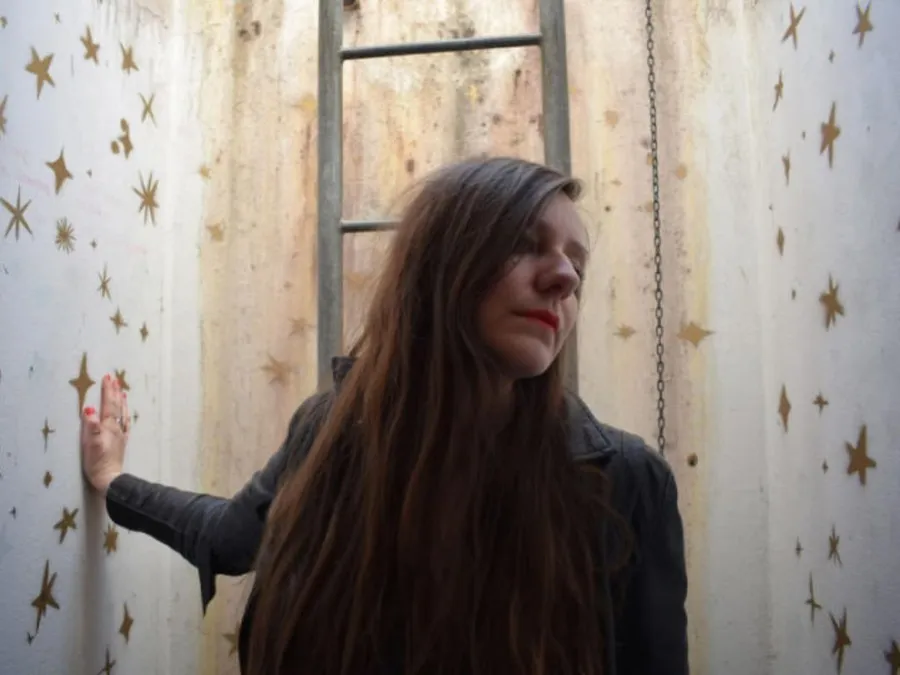
Sauvageoness, the Swiss solo project of Carro Loubère (torpedo), releases its second album "A Maze Deep In". It is a "doomed industrial dream pop" record about love's pilgrimage, conscious decisions and the labyrinth within. We spoke with Carole Obère.
Warning: reading this interview may leave you unable to think about love without a labyrinth somewhere in the picture. I was still deep in the torpedo conversation when I already knew I needed to speak with Carro Loubère again. Because alongside torpedo, she leads an entirely different life. As Sauvageoness, her Swiss solo project, she stands alone on stage with a guitar and machines. "A Maze Deep In" is the second album, released on 22 May 2026, mixed and mastered by Jack Shirley at The Atomic Garden in Oakland. The sound is a radical step away from the folk poetry of debut "PHOEBE" (2024), into something that calls itself "doomed industrial dream pop". Drawing on shoegaze, post-punk, noise, and the emotional intensity of black metal. The album tells of love's visceral pilgrimage, attempting to incarnate on Earth. I had the chance to ask Carro, or rather Carole Obère, as she goes by in the Sauvageoness context, a few questions. Please enjoy my interview!
Anne: Carro, it's so lovely to have you back! We spoke recently about torpedo, and honestly, I was already hoping we'd get to do this again soon. Sauvageoness has been sitting in the back of my mind ever since. I'm delighted to get to talk about this side of your work now. So, first things first: how are you?
Carro: Dear Anne, very happy to speak with you again! I can't wait to discover your questions and to answer them from my Sauvageoness side, where even my name switches a little. I will reply as Carole Obère, here!
I'm doing very fine today! I just got the vinyls of "A Maze Deep In" delivered this afternoon, and they are just so beautiful. I'm overwhelmed with happiness, and I'm truly amazed.
This is doing me good after a pretty difficult time lately. We had to leave the studio we occupied for almost 20 years. Where we composed and recorded most of the music of torpedo and Sauvageoness. We will definitely keep this place in our hearts, like our best friend.
The thing is that even if we had found the most beautiful, cool spot to move to, we would have been crushed and devastated to leave this place. Never, ever could we have been OK without even considering leaving this beloved place.
"I Wanted to Die in There, to Be Buried in the Tiny Hole under the Ladder, Seeing the Stars from My Grave"

I wanted to die in there, to be buried in the tiny hole under the ladder, seeing the stars in the sky at night from my grave, through the metal structure outside, which we held, like hugging, each and every day, each and every time we were entering and going out from the trap by the ladder, for almost 20 years. But we had to leave this beloved place.
Even if the situation was desperate, if people involved were awful, contemptuous, and violent, coldly hiding behind bureaucratic norms, acting without empathy and focused only on profit. What talks metaphorically about the banality of evil, as well as pointing out the fact that the banality of evil always needs individuals who are ready to organise institutional violence (at different levels), individuals who are acting in these processes and very much putting them in place, even thinking them. This is one of the roots of the violence in our societies, which this album also seeks to highlight.
Another aspect that reflects and echoes the album in this situation is that even if this situation was terribly painful and desperate, we decided to love this beloved place until we finally closed its door.
We loved this place at every moment, honouring its entire character. Despite the rage of knowing it would be left empty by a real estate landlord deaf and blind to anything but profit. Despite being thrown away after proposing a beautiful project of an art and cultural centre. Despite finding a place to go only the day before relocating, and receiving no help in this situation other than our very close community. And so, even if all the rage, the anger, the disillusion, the high tension was hurting our sensibility harshly. We consciously decided to stay in a loving posture and did everything to continue caring for this beloved place, to cherish it until the very end, and to allow ourselves to be completely torn apart by our love for this place, our safe place, our creation space. Irreplaceable. I can’t really describe to you what has been happening to me emotionally in this situation; I'm unable to speak. The darkness. It was like losing our best friend, to prepare him for the grave by ourselves and bury. "A Maze Deep In" is talking about the conscious act we need to fulfil and the decision to make to keep loving, and loving fully, in an unbearably violent society, blind, harsh, toxic, polluting and would turn any heart into stone and kill everything around, if we don’t understand what’s going on and take care of our hearts, of communities and more generally of life.
Anne: One of your press releases described "A Maze Deep In" as a story about love's visceral pilgrimage attempting to incarnate on Earth. That is an unusually abstract starting point for a pop record. What specific experience or moment led you to think of love as something that still needs to arrive? As if it hasn't quite made it here yet?
Carro: "A Maze Deep In" is about the pilgrimage of love to incarnate fully on Earth, not because it needs still to arrive or hasn't quite made it here yet, but more because the hardness of life in our own society, the violence of our kind and our way of living, need us at some point to be willing to love, decide consciously to do so and stay in a loving posture, rather than turning our heart, our life off, because of the pain, the heaviness, the alienation present at some more or less suffocating degrees in contemporary human life in this society, or even because of the fake rhythm imposed to our society by its own industrial machinery.
There are three essential elements on the record. The need for joy, beauty, tenderness, empathy, kindness, innocence, and so generally the moon, flowers, birds, colours, the sky, the sea (aka poetry, mystery, and harmony) in order to be strong and stay strong enough to find our way into human society, to stay alive and alive at heart. A second element is clarity. Seeing in different tones of shadows, looking at what is happening here, looking at the problems, talking about them, pointing them out in frontal and direct talks, getting rid of the social masquerade and being able to build sincerely together something beautiful. This second element is one of lucidity. Lucidity implies seeing in the dark, to be voyant, a seer, a visionary, no matter the amount of dark or of light we’ve got. By understanding, lucidity allows us to take back our own power and, furthermore, to consciously get rid of the sick power structures of domination. To wilfully renounce them on behalf of harmony. And the third element is about metamorphosis, rituals, and transcendence. Transcendence of our actual collective way of living, dominated by ego. And in order to reach this point of transformation, we definitely need a conscious action of love.
"The Album Is about Mastering Love's Energy Collectively, to Create a More Beautiful, Intelligent and Peaceful Society"
Finally, to answer your question, the album is more about mastering love’s energy collectively, and so to create a more beautiful, intelligent and peaceful society. Master in a positive sense: being able to live in these very high energetic frequencies where also reside creativity, gratitude, innocence, harmony, and peace. What we don’t seem to be able to do, for now, at a collective level!
Anne: "PHOEBE" (2024) was shaped by folk poetry and intimacy. "A Maze Deep In" carries the tag "doomed industrial dream pop" and explicitly draws in the intensity of black metal. What shifted in you between the two records to make such a radical change of sound necessary?
Carro: I don't think anything changed in me this way, but it was already there. And "PHOEBE" was a way for me to access to some tenderness inside my own Maze! To make it available for further releases. So that "A Maze Deep In" took some of it and mixed it with my original harshness.
Anne: Jack Shirley mixed and mastered "A Maze Deep In" at The Atomic Garden in Oakland. He also worked on torpedo's "What the fucked do we all do now? | - Lights." What does it feel like to bring the same producer into two such different projects? What is it that he offers? A secret?
Carro: It always feels good to work with Jack! We worked with him on a few singles before torpedo's last album, and we just love to work with him. He always makes things sound so cool, sharp and perfectly balanced! We love his work, and he has the skill to work on very different kinds of music perfectly, so that the different styles of the records were not a problem at all. I think he offers speed. We have worked so quickly and so well together on "A Maze Deep In"—I love that! As well as working with someone who knows where he is going and where it is good to go for each project. He also engineered the album and recorded part of it.
Anne: According to the announcement, your album divides into two distinct halves: five tracks of atmospheric industrial gloom, followed by post-punk and the hardcore energy of "mio stars at the end." Was that two-part structure planned from the beginning, or did the album find its shape as it was being made?
Carro: There are three, in fact. These two plus the transformative element that appears the most in the last three songs. I’ve recorded twenty-five songs altogether in this session. What I did not know exactly was that they were going to make three releases, in fact. As the composition, recording and starting of mixing processes were pretty quick, I just knew at that moment that I had everything I needed to record! Then the songs came together nicely and easily and formed the three ensembles. So "A Maze Deep In" wasn’t thought of at first as a three-part structure. Albums, as songs, are surpassing us by far, organising by themselves and telling things we did not even think we could express that deeply! And so, for me, it was a matter of listening fully to what I know on another level, and respecting that. Here, I just knew I had enough songs recorded, and everything was going to be fine in the end! And this magic, unknown part of me was right—the vinyl is here, and it is incredibly beautiful.
Anne: Sauvageoness means standing alone on stage with a guitar and machines. In torpedo, you have shared that stage with Jay Liseron and Drew Hammer for years. What changes in your own voice and in your body when there is no one standing next to you?
Carro: What changes the most is to be standing alone and relying only on myself, my body, my groove, my rhythm, my playing, my voice, my memory. Also, to deal only with myself, which is not always easier.
"Throw Me into the Deep Woods, Standing Alone, on My Own Sweet"
Also for a long time, even before the composition process had really started for this album—some songs were composed pretty long time ago, but most of the twenty-five songs recorded were composed in January 2025—when I was writing about the album and already working for it without knowing it really, I was calling this future ensemble: "throw me into the deep woods to standing alone, on my own sweet." So there is a lot about something about standing by myself and holding in this solo project.
Anne: "mio stars at the end" is both a track title and the emotional destination of the album. The phrase feels cosmic and deeply personal at the same time. Like someone finally seeing the sky after a long journey. What is behind that image for you?
Carro: Someone finally seeing the sky after a long journey, a trip to hell maybe? Et dès lors, nous sortîmes revoir les étoiles? E quindi uscimmo a riveder le stelle. I hear Dante in this question. That’s the moment when we came out of Hell! There is probably a link to The Divine Comedy in this album. The stars are everywhere there too, and so is love, which is moving everything: L’amor che move il sole e l’altre stelle!
"E quindi uscimmo a riveder le stelle—and So We Came Out to See the Stars Again"
I like this question! "mio stars at the end" is certainly referring to the image of purgatory. We need to follow the stars to navigate in this life and get to the real and raw emotional destination, which is definitely for me "Ex Voto Ardent", and the rawness of passion. And from there, rise to the stars of a real, true, and raw love energy that would allow us to elevate as a kind and transcend our actual collective dead ends.
The song is marked by this second element of the album, the one of clarity, understanding and also criticism, honesty toward the problems we as a society have to face to be able to create a sustainable way of living, that would allow us to unify with the world, rather than being only able to be separate and to destroy. This second element is some kind of purgatory to me.
And stars are certainly divine guides to paradise. Steadfast and beautiful, they are. Pure love dropped from the sky. If we follow their spiritual teaching, at some point, we might be strongly creative enough and non-dominant, aka harmonious, enough to create a world simply beautiful, together as pacified animals.
Anne: The lead single is called "Mary." It is a name carrying enormous symbolic weight, biblical, poetic, and historical. Which Mary do you mean? Or is it precisely the ambiguity of the name that drew you to it?
Carro: Yes, it is a name with a great symbolic weight, and I’m very touched by the abundance of meanings, the mystery of this word.
The song’s lyrics were always: "Don’t you want to?" But at first, the song finished with "… to marry me."
I mean a lot of Marys, but particularly as an image of spring and rebirth, empathy, kindness and unconditional love as well as sensuality. Mary is also a strong symbol of union. Of the ability to be unified with the world, or to be both the divine and the animal. It is talking about the ability of love to incarnate by its own will, which is surpassing us by far. Like, we can do anything, but steadfast love will still blossom in spring, whether we want it or not!
Though "Mary" is connected on the album and on live too, with "RD Paradise." Together, this small ensemble inside the album is talking about love, the innocence of love, and the sense becomes more complex as it integrates other elements about the fragility of Lovers’ Eden, lost love and how and if we can get back from a lost paradise. It’s talking about lies, about betrayal, about physical and psychological violence, about defect, fault, imperfection, deficiency, weakness, inadequacy, flaws, breaks, cracks in the personality as well as masks; it is talking about the human condition! And how we transcend these conditions, defects and weaknesses, and how and if we can come back from them.
At that point, we often need to be willing, decide on our free will, or have a conscious loving action to get out of betrayal, deal with the unbearable loss, to heal, rebuild and be able to love again. Even if it sometimes seems impossible to heal or to be strong enough to continue. This is one of the themes of "Road_ise Cherubim." "Mary" + "RD Paradise" as one ensemble is talking about resilience and the ability we need to work out to be able to deal with the hardness of life and continue to be loving beings. So, about how we can get back from traumatisation in following our own stars. And with their light, find our own way.
"Love Finds Its Way Out of the Maze by Metamorphosis"
This is how our lives are changed, and how we are redeemed, cause everyone who falls has wings.
Anne: For "PHOEBE", you created a very physical object: a fanzine, poems, hand-crafted cover art, everything in a paper bag shipped from Switzerland. What role does the material, the tactile, play in your music, and does "A Maze Deep In" get a similarly bodily presence as an object?
Carro: Yeah, "PHOEBE" took the form of a craft-handed zine, that I even decorated occasionally! So every copy of the album has been made by me. And decorated copies are always unique.
I love that music incarnates in a physical body. It is a way to bring this idea to the materiality of this world. So for me, it is essential for the life of the idea to get as well a physical incarnation so that it can develop like a plant, but of thoughts. Our collective consciousness and unconsciousness are some very natural spaces for me. They are parts of what is living on Earth, I’d say. So we can plant seeds there, like in our gardens. Albums are ways to cultivate our individual and collective minds.
In my work, I am very focused on planting seeds that will clear and clean and help our collective way of thinking to develop toward a beautiful creation together.
So normally, albums take a physical form. "A Maze Deep In" is released on vinyl! And as I said previously, they just arrived, and now that I have them in my hands, I can say: this album has a very dawny, shiny, beautiful and loud material presence!
Anne: On "PHOEBE", one track used verses from a poem by Denise Levertov, a poet whose work moves between tender everyday detail, spiritual searching, and political fury. Do Levertov's voice or other literary sources accompany you on the new record as well?
Carro: The poetry of Denise Levertov is moving me intensely. The lyrics of several tracks on "PHOEBE" come from Denise Levertov's poems. The recording session for "PHOEBE" gave a good number of compositions, too, almost thirty. Others of her poems came together with my music at that time. I’ve been particularly touched by the tender of everyday detail, yes. I am also always a huge fan of Lenore Kandel. But all the authors present on "PHOEBE" and on this cycle of composition have had an influence and were an inspiration for this album too, of course.
There are, of course, references here and there to literature. In "RD Paradise", there is a verse from Yeats, for example. One thing about my work, which is also linked to the idea of a maze, is about mystery. What is a very essential thing for our life, for the fire in our heart, for desire as a living force? So I love to craft and write songs and lyrics that spell around this idea.
Anne: The album title "A Maze Deep In". A labyrinth, deep inside. In classical mythology, the labyrinth is not a place of punishment but a place of transformation. Does love find its way out of this maze, or does it remain lost inside? What is your version of the exit?
Carro: My version is definitely a place of transformation. A human transformation toward love, peace, and freedom. For a shift in our matter, individually and collectively. That's what I've worked on in this record, what I hoped it would do, feel, inspire and be. Metamorphosis and transformation. A way to it, a hand toward it. For us to shine through the intensity of passion, the rawest intensity of life and love, toward harmony.
Yes, love finds its way out of the maze by metamorphosis. If love wouldn't, I wouldn't be here answering your question with the freshly born records by my side.
James Baldwin: "And Love Will Simply Have No Choice but to Go into Battle with Space and Time and, Furthermore, to Win"
I love this quote from James Baldwin: "And love will simply have no choice but to go into battle with space and time and, furthermore, to win."
Anne: Black metal appears in the description of this album. Not as a genre label but as an attitude towards intensity. Which records or artists from that world shaped your understanding of what hardness can do emotionally?
Carro: On "A Maze Deep In", black metal is present mostly as touches on different levels of the music. "Ex Voto Ardent", for example, is the song that is the most influenced by black metal sound and intensity. Here, it appears on the drums, on the guitars, but vocals, and most of the themes of the song are escaping this label. This song is about passion. In other songs, the touches appear on guitars like in "RD E|A", or in "Road_ise Cherubin" for example. And yeah, it appears as an attitude towards intensity.
In "Ex Voto Ardent", rather than hardness, it translates the intensity, the rawness of desire that burns us with its very raw energies of furious passion that doesn't give a fuck about social filters. This is a very pure energy of untamed love and deep healing for our souls.
This song is a call to let the very raw energies of love be a guide for our lives and a way to transcend the part of the social ritual that traps us into some false decency. It is an unmasking energy of honesty, so essential in a society asphyxiated by the rails in which it is stuck, blindly on the wrong track, lying to itself. By fear of metamorphosis for a part of us who remaining masked or remaining only masks. Yet, this raw energy is unmasking and creating true love.
I'd say that the very raw life experience of hardness I've had in my younger years, childhood and teenage years, shaped and gave me a very clear understanding by experience of what hardness can do emotionally. And then artists and records have echoed strongly this experience, feelings, and understanding of life. I found in their expression, their work, and the frequencies and elements of their work a resonance with my feelings. I guess it is more in this sense that I got a comprehension of what hardness can do emotionally. I could talk about a lot of them, but I've chosen a few.
Of course, all of Oathbreaker! I love "Sunbather. I've been listening so much to this particular album from Deafheaven. I'm very in adoration with "Threshold" from Cloud Rat. This band is for me an amazing mix between love and intensity, a spaceship through the hardness of life with love. They are not strictly black metal, of course. Ulver, Botanist, Machukha - images from this project inspired part of the lyrics of "Ex Voto Ardent". I've cried like a baby in front of it. Dödsrit, Mizmor (especially with "Prosaic") and Agriculture (s/t) are some of the albums and artists I've really found nourishing for my music. Though it is not black metal either, but it is speaking about intensity, Amenra truly shake me with the fantastic emotional dynamic of their music. As well, do YOB. Many of them have gone through Jack's studio, though!
Anne: In torpedo, "What the fucked do we all do now?" circles around collective pain, political paralysis, and what James Baldwin calls the death of the heart. Sauvageoness goes searching for love. Do the two projects speak to each other, and is the love in "A Maze Deep In" in some way a response to the silence torpedo describes?
Carro: This is very interesting to see it like this. "A Maze Deep In" was composed much after the last album of torpedo. But it surely seeks to restart the heart as well.
"Sauvageoness Doesn't Search for Love—It's All Already Here"
Sauvageoness doesn’t search for love because it’s all already here. But it searches for the way to this garden that is inside the maze inside being and accessible by transformation. Mainly the transformation of the human ego.
They probably talk together, as all thoughts fly. In some ways, “What the fucked do we all do now? | - Lights” talks about the agony we are lying in as a society. This album starts the reflection on peace. What is it really? This album talks more about the fear of change; it seeks these possibilities and so is imagining and creating new paths to something harmonious.
And Sauvageoness in “A Maze Deep In” talks more about the change itself, fear as gone and metamorphosis as an existing possibility. New frequencies are available, and consciousness evolves.
Anne: What comes next? What's beyond "A Maze Deep In" already taking shape, for Sauvageoness, for torpedo, or something entirely different? torpedo is working, writing and composing right now!
Carro: Concerts and a very singular thing coming next for Sauvageoness! I can't wait to share it with the world! I will talk about it pretty soon. But lots of things have been recorded during this creative session from where "A Maze Deep In" comes from!
It was again a pleasure to speak with you, Anne. Your questions bring fruitful reflections for me! Thank you for your very interesting conversation, and thank you for having Sauvageoness.


